

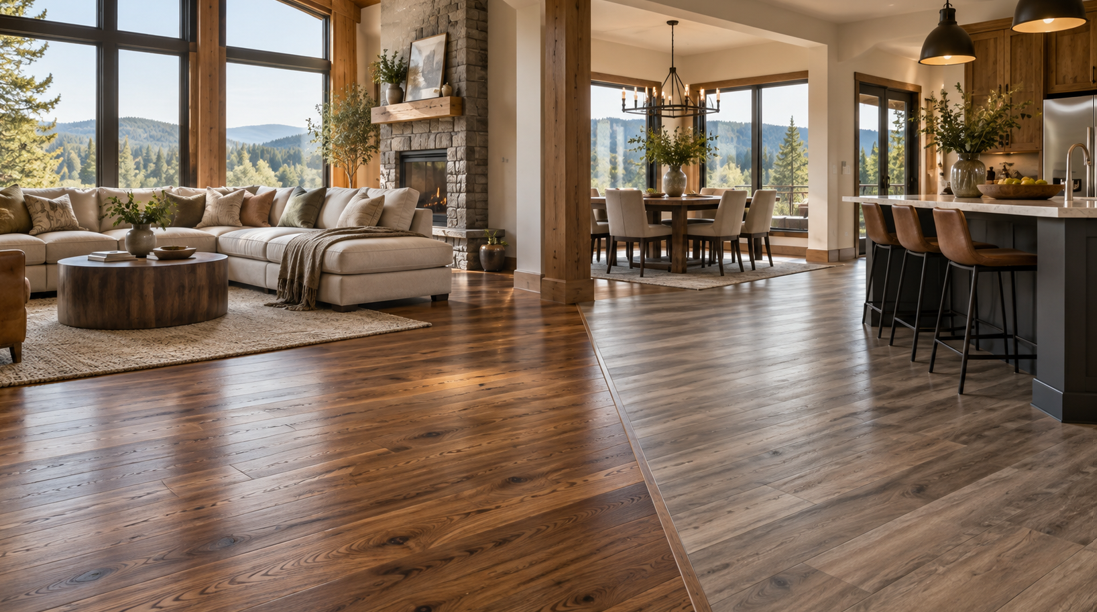
Choosing between luxury vinyl and real hardwood is one of the most common flooring decisions homeowners face. Both can create a warm, attractive interior, and modern luxury vinyl can reproduce the look of natural wood remarkably well. But appearance is only one part of the decision. Moisture resistance, durability, comfort, maintenance, installation conditions, long-term value, and the way your household uses each room all matter.
For homeowners in Moscow, Idaho, regional conditions add another layer to the choice. Cold winters, seasonal moisture, changing indoor humidity levels, and four distinct seasons can all influence how flooring performs over time. The best option is therefore not simply the one that looks best in a sample. It is the one that fits your home, lifestyle, budget, and expectations.
At Superior Floors, flooring decisions are approached with those practical considerations in mind. Superior Floors Inc brings more than 80 years of combined family flooring expertise to homeowners throughout the Palouse region, helping customers compare materials based on both appearance and real-world performance.
If you are deciding between luxury vinyl and hardwood, this complete comparison will help you understand where each option shines and where the trade-offs matter.
What Is Luxury Vinyl Flooring?
Luxury vinyl flooring is a resilient flooring product designed to combine durability with realistic visual detail. Many products are manufactured as planks, which is why the term luxury vinyl plank, or LVP, is commonly used.
Modern luxury vinyl can replicate a wide range of wood species, grain patterns, plank widths, textures, and colours. Rather than relying on the flat or artificial appearance associated with older sheet vinyl, today's products are designed to create a more convincing wood-inspired surface.
One of luxury vinyl's biggest advantages is practicality.
Depending on the specific product, luxury vinyl may offer strong water resistance or waterproof performance, making it appealing for kitchens, bathrooms, laundry areas, entrances, finished basements, and other spaces where spills or moisture may occur.
It can also be relatively easy to maintain, which appeals to busy households with children, pets, frequent visitors, or active lifestyles.
What Is Real Hardwood Flooring?
Hardwood flooring is made from genuine wood. It is available in two main forms: solid hardwood and engineered hardwood.
Solid hardwood is milled from a single piece of timber. It is valued for its authentic appearance, natural variation, long service life, and potential to be sanded and refinished over time.
Engineered hardwood uses a real hardwood surface layer over a layered core. It still provides the appearance and feel of genuine wood but is constructed differently, which can offer additional dimensional stability in certain installations.
With either option, no two boards are completely identical. Natural differences in grain, knots, colour, and character create the variation that many homeowners value.
Hardwood also develops character over time. Depending on the species, finish, household activity, and maintenance, a real wood floor may show subtle changes that become part of the home's appearance rather than simply looking manufactured and unchanged.
Luxury Vinyl vs. Hardwood: Appearance
For many homeowners, appearance is the starting point.
Hardwood has the advantage of authenticity because every plank is made from genuine wood. Natural grain variation, colour differences, knots, mineral streaks, and texture give hardwood a depth that manufactured flooring aims to reproduce.
If natural material and individual plank character are priorities, hardwood remains difficult to replicate perfectly.
Luxury vinyl, however, has advanced considerably.
High-quality vinyl can reproduce wood grain, knots, colour variation, and textured surfaces with impressive realism. It is available in designs inspired by oak, hickory, maple, walnut, and other popular wood looks, as well as contemporary wide-plank and rustic styles.
The difference often becomes more noticeable when you examine the floor closely or across a large installation.
For some households, authentic natural variation is worth prioritising. For others, achieving a convincing wood look with easier maintenance and moisture resistance is more important.
There is no wrong preference. The decision depends on how much value you place on natural material compared with practical performance.
Which Flooring Handles Moisture Better?
This is one of the most important differences.
Wood is a natural material that responds to changes in moisture. Excessive moisture can contribute to swelling, cupping, movement, or other problems if environmental and installation conditions are not properly managed.
That does not mean hardwood is unsuitable for the Palouse. It means the flooring needs to be matched carefully to the room and properly installed.
Seasonal weather is particularly relevant. Rain, snow, spring moisture, and wet footwear can all increase the amount of moisture entering a home. Indoor humidity can also shift as heating systems run through the colder months.
Luxury vinyl generally offers a greater degree of moisture tolerance.
Many vinyl products are designed specifically for areas where water exposure is more likely. Waterproof options can be especially useful in kitchens, bathrooms, utility rooms, entrances, and some basement applications.
However, waterproof flooring should not be confused with a solution for underlying moisture problems. If a subfloor or basement has an active moisture issue, that condition should still be investigated before new flooring is installed.
Durability in Busy Households
Durability means different things to different homeowners.
A household with two adults and little foot traffic has different flooring demands from a household with children, dogs, frequent guests, and direct access to the outdoors.
Luxury vinyl is often chosen for demanding spaces because it is designed to resist everyday wear. Product quality and wear-layer construction vary, but many options can handle scratches, spills, and routine household activity with relatively straightforward care.
This makes luxury vinyl flooring worth considering for active homes where easy maintenance and resilient performance are priorities.
Hardwood is durable in a different way.
It can develop scratches, dents, and surface wear more readily depending on the wood species and finish, but real hardwood has a major long-term advantage: many floors can be refinished.
Instead of replacing the entire floor when the surface eventually becomes worn, appropriate hardwood can often be sanded and given a new finish. This can significantly extend its useful life.
So the durability comparison depends partly on your time horizon.
Luxury vinyl may resist everyday problems effectively from the beginning. Hardwood may require more attention to surface care but can offer exceptional longevity when properly maintained.
Pets, Children, and Everyday Life
Families should think about how the floor will actually be used rather than how it will look on installation day.
Pets can bring claws, water bowls, muddy paws, and shedding. Children introduce spills, toys, chair movement, craft projects, and energetic daily activity. Busy entrances can collect grit and moisture from outdoors.
Luxury vinyl can be attractive in these situations because it is generally easy to clean and available in products designed for demanding residential use.
Hardwood can also perform well in family homes, but households may need to be more deliberate about protective measures.
Entry mats can help reduce dirt and grit. Furniture pads can minimise scratches. Spills should be cleaned promptly. Pet nails should be maintained, and protective rugs may be helpful in particularly active areas.
Some homeowners are completely comfortable with the natural patina that develops on wood. Others prefer a surface that stays more visually consistent.
Your expectations matter just as much as the material itself.
Comfort and Feel Underfoot
Real hardwood has a natural feel that many homeowners appreciate. Because it is genuine wood, it can provide a sense of warmth and solidity that contributes to the overall character of a room.
Luxury vinyl feels different, although product construction and underlayment can influence the experience.
Some vinyl products provide more resilience underfoot, while others feel relatively firm. The subfloor and installation method also affect sound, comfort, and the way the finished floor feels when walked on.
This is an area where showroom samples alone may not tell the entire story.
Whenever possible, compare larger installed displays and consider how each product feels as well as how it looks.
Maintenance Requirements
For many homeowners, maintenance can be the deciding factor.
Luxury vinyl is generally straightforward to care for. Routine sweeping or vacuuming removes grit, and appropriate damp-cleaning methods can take care of normal dirt and spills.
Specific cleaning recommendations vary by manufacturer, so homeowners should always follow the care instructions for the selected product.
Hardwood also benefits from routine removal of dust and grit, but moisture needs to be handled more carefully. Standing water should be avoided, and cleaning products should be suitable for the floor's finish.
Furniture protection and humidity awareness may also be more important with real wood.
Neither option should be considered maintenance-free.
The question is whether you are comfortable giving hardwood somewhat more attention in exchange for natural material and refinishing potential, or whether easier day-to-day upkeep is a stronger priority.
Installation and Subfloor Considerations
The quality of the finished floor depends heavily on what is underneath it.
Subfloors should be clean, stable, appropriately dry, and sufficiently level for the selected flooring system. This becomes especially important in established regional homes, where previous renovations, older construction methods, floor height differences, or hidden repairs may affect installation.
Luxury vinyl can sometimes be installed using floating systems, while other products may use different installation methods. Product specifications and subfloor requirements should guide the decision.
Hardwood installation also varies depending on whether the material is solid or engineered and what type of subfloor is present.
Acclimation may be necessary, and moisture conditions should be evaluated carefully.
This is why choosing flooring before understanding the installation environment can lead to problems. A product should not be selected solely because a sample looks attractive.
The home itself needs to be part of the decision.
Which Option Works Better in Different Rooms?
Rather than asking whether luxury vinyl or hardwood is better overall, ask which one makes more sense in each room.
Living Rooms
Hardwood is a natural choice for living rooms because appearance and continuity are often priorities. Genuine wood can help create a warm, established feel and works well with both traditional and modern interiors.
Luxury vinyl can also work well, particularly when homeowners want a wood appearance with simplified care.
Kitchens
Kitchens present more frequent exposure to water, food spills, dropped objects, and heavy foot traffic.
Luxury vinyl is often appealing here because moisture tolerance and easy cleaning are major advantages.
Hardwood can still be used in kitchens, but homeowners should be comfortable with prompt spill clean-up and appropriate maintenance.
Bedrooms
Both materials can work well.
Hardwood provides natural character and long-term appeal, while luxury vinyl offers durability and straightforward maintenance. Area rugs can add softness to either choice.
Bathrooms
Because bathrooms regularly experience water and humidity, appropriately rated luxury vinyl is generally the more practical of the two options.
Traditional hardwood typically requires more caution in spaces with frequent moisture.
Entries and Mudrooms
These are demanding areas in Moscow homes, particularly during wet or snowy weather.
Luxury vinyl can be a strong candidate because dirt, grit, and moisture are likely to be tracked inside.
If hardwood is used near an entrance, good mats and regular maintenance become especially important.
Finished Basements
Basements require careful moisture evaluation before any flooring is selected.
Where conditions are appropriate, luxury vinyl may be attractive because of its moisture-resistant characteristics. Existing water or subfloor moisture problems should be addressed rather than covered.
Which Flooring Is More Affordable?
There is no single price for either material.
Luxury vinyl prices vary widely depending on construction, design detail, thickness, wear layer, brand, and installation requirements.
Hardwood pricing also varies based on species, grade, plank dimensions, construction, finish, and whether the floor is solid or engineered.
In many cases, luxury vinyl can provide a wood-inspired appearance with a lower initial material investment than premium hardwood.
Hardwood, however, should also be considered from a long-term perspective. A quality hardwood floor may remain in a home for decades, and its ability to be refinished can extend its useful lifespan.
The best comparison is therefore not simply the purchase price per square foot.
Consider material, preparation, installation, maintenance, expected service life, and the likelihood that the flooring will need to be replaced in the future.
What About Home Value?
Real hardwood has long been associated with premium residential interiors. Its authenticity and longevity can make it attractive to homeowners who view flooring as a lasting investment in the property.
Luxury vinyl appeals for different reasons.
A well-chosen vinyl floor can make a home feel updated, cohesive, and easy to maintain. In practical spaces, buyers may value waterproof or water-resistant flooring and a modern wood look.
However, flooring alone does not determine property value, and homeowners should be cautious about assuming that any particular flooring project guarantees a specific financial return.
The strongest reason to choose either material is that it suits the home and the people living there.
Style Options for Moscow Homes
Both hardwood and luxury vinyl offer considerable design flexibility.
Natural and warm wood tones work particularly well with the agricultural and rustic influences found throughout the Palouse region. They can complement painted cabinetry, natural stone, farmhouse details, neutral walls, and traditional furniture without making the room feel overly themed.
Wide planks can create a more open, contemporary effect, while narrower boards can complement established homes and traditional interiors.
Matte and lower-sheen finishes are also worth considering because they can create a relaxed appearance and may make everyday dust or minor surface marks less noticeable than highly glossy floors.
For luxury vinyl, avoid choosing a design only because it closely imitates a particular wood species. Consider the complete pattern across several planks.
Natural-looking colour variation and less obvious pattern repetition can contribute to a more convincing finished floor.
Can You Use Hardwood and Luxury Vinyl in the Same Home?
Absolutely.
In many cases, this is the most practical approach.
You might use real hardwood throughout living spaces and bedrooms, then choose luxury vinyl in a kitchen, laundry area, bathroom, or busy entrance.
The challenge is making the transition look intentional.
Trying to match hardwood and vinyl perfectly can sometimes make small differences in grain, colour, sheen, and plank dimensions more obvious. Complementary materials may work better than near-identical ones.
Consider sightlines between rooms, transition locations, plank direction, trim, cabinetry, and lighting.
A carefully planned combination can give homeowners the advantages of both materials without making the home feel visually disconnected.
Questions to Ask Before Making Your Decision
Before choosing between hardwood and luxury vinyl, think through the way your household uses the space.
Ask yourself:
How much moisture is the room likely to experience?
Do children or pets use the space frequently?
How much maintenance am I willing to do?
Is natural material important to me?
Do I want the possibility of refinishing the floor later?
How long do I expect to keep the flooring?
What is the condition of the existing subfloor?
Does the new floor need to connect visually with adjacent rooms?
Is initial cost more important than long-term service life?
How will seasonal Palouse conditions affect the space?
Answering these questions often makes the decision considerably clearer.
Luxury Vinyl or Hardwood? Choose for the Way You Live
There is no universal winner in the luxury vinyl versus hardwood comparison.
Real hardwood provides natural beauty, authentic variation, long-term character, and the possibility of refinishing. It can be an excellent choice for homeowners who value genuine materials and are prepared to give the floor appropriate care.
Luxury vinyl provides a convincing wood-inspired appearance with strong practical advantages. Moisture resistance, straightforward maintenance, and suitability for busy areas make it an excellent option for many modern households.
For some homeowners, the right answer will be hardwood throughout most of the home. For others, luxury vinyl will better match the realities of pets, children, moisture, or maintenance preferences. Many homes benefit from a carefully planned combination of both.
What matters most is making the decision based on your rooms, subfloor conditions, lifestyle, and long-term expectations rather than choosing from appearance alone.
With more than 80 years of combined family flooring experience, Superior Floors Inc helps Palouse-region homeowners compare materials with those practical details in mind. If you are planning a flooring update and want to see how luxury vinyl and hardwood options look in your own space, request a free estimate and discuss the needs of your project with a local flooring professional.


