

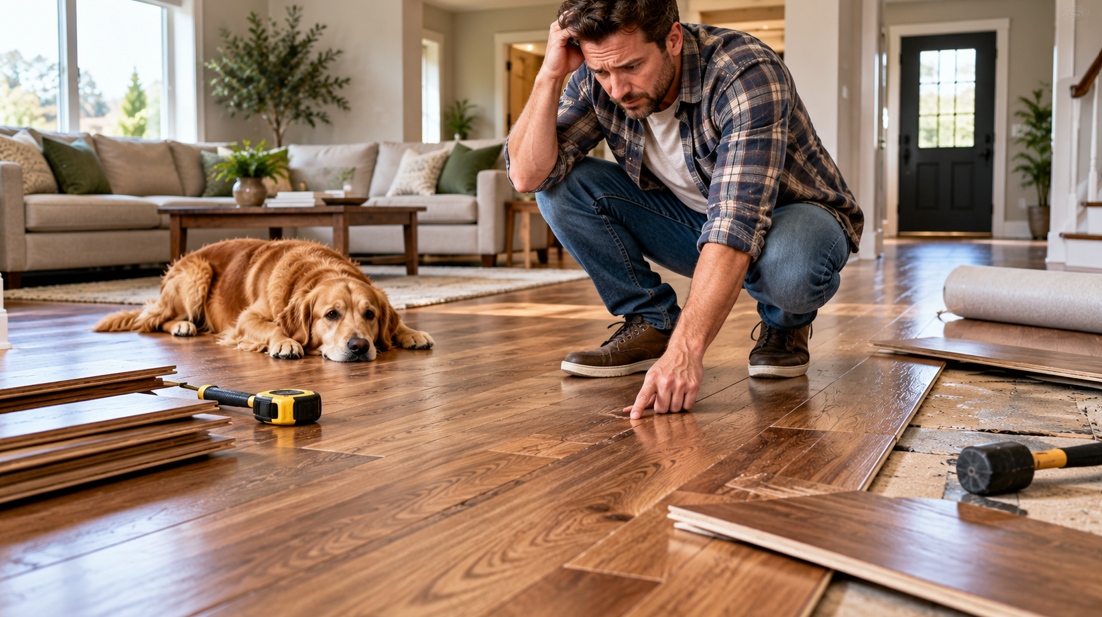
Hardwood flooring can completely change the character of a home. Natural grain, warm tones, and long-lasting appeal make wood an attractive choice for everything from traditional properties to modern renovations. But getting a beautiful result involves more than finding a plank that looks good in a sample.
Product construction, moisture conditions, subfloor preparation, installation, finish, daily traffic, and long-term maintenance can all affect how a hardwood floor performs.
Those considerations are particularly important for homeowners in Colfax, WA and across the Palouse, where cold winters, warmer summers, spring moisture, and seasonal changes in indoor conditions can put natural wood through repeated expansion and contraction cycles.
At Superior Floors, we help homeowners consider the complete flooring project rather than simply choosing a colour from a display. With more than 80 years of combined family flooring expertise, our team understands the regional conditions, established homes, and practical household concerns that can influence a successful hardwood installation.
If hardwood flooring is part of your renovation plans, avoiding these seven common mistakes can help you make a more confident decision.
Mistake #1: Choosing Hardwood Based Only on Colour
Colour is often the first thing homeowners notice.
You may immediately be drawn to a warm natural oak, a rich brown floor, or a lighter contemporary finish. Colour certainly matters, but it should not be the only factor guiding the decision.
Two hardwood floors that appear similar at first glance may differ significantly in:
Wood species
Hardness
Construction
Surface texture
Finish
Plank width
Natural grain variation
Installation requirements
Maintenance expectations
A household with children, dogs, and regular entertaining may have different priorities from a quiet two-person household. A room receiving heavy foot traffic may need different consideration from a formal bedroom.
Natural wood also contains variation.
One small sample cannot show every grain pattern, knot, mineral streak, or tonal change that may appear across an entire room.
How to Avoid This Mistake
Begin with performance and lifestyle questions before narrowing your colour choices.
Consider:
Which rooms are being updated?
How much traffic will the floor receive?
Are pets or children part of the household?
How much natural light does the room receive?
What existing cabinets and trim need to work with the new floor?
Do you prefer uniformity or visible natural character?
Once you understand what the floor needs to do, you can choose from colours and styles that meet those practical requirements.
This approach keeps appearance important without allowing it to overshadow long-term performance.
Mistake #2: Ignoring Seasonal Moisture and Humidity
Hardwood is a natural material.
Changes in moisture and humidity can cause wood to expand and contract. Some seasonal movement is normal, but excessive changes can create problems.
This is particularly relevant in the Palouse region.
Homes move through distinct seasons, with cold winters, spring snowmelt and rain, warmer summers, and changing indoor heating conditions. Those transitions can affect the environment surrounding a wood floor.
Homeowners sometimes make the mistake of treating hardwood like an inert material that will remain exactly the same regardless of its surroundings.
It does not.
Moisture conditions can influence:
Board movement
Gaps
Cupping
Crowning
Expansion
Overall floor stability
The goal is not to prevent wood from responding naturally to the environment. It is to select and install the flooring in a way that accounts for those conditions.
How to Avoid This Mistake
Discuss the environment of your home before choosing the product.
Questions might include:
Is the flooring going above or below grade?
What type of subfloor is present?
Has the home experienced moisture issues?
How is indoor humidity managed?
Does the room experience major seasonal temperature changes?
Depending on the project, engineered hardwood may be worth considering because its layered construction can provide greater dimensional stability in some situations.
Solid hardwood may be an excellent choice in others.
There is no universal answer, which is why local conditions matter.
For a Colfax homeowner, a flooring recommendation should take the Palouse climate into account instead of assuming that a product appropriate in one region will automatically be ideal in another.
Mistake #3: Treating All Hardwood as the Same Product
The phrase "hardwood flooring" covers a broad category.
One of the most common mistakes homeowners make is assuming that every hardwood option differs only in colour and price.
In reality, there are important differences.
For example, solid and engineered hardwood are constructed differently.
Solid hardwood is made from solid wood through the thickness of the board. Engineered hardwood generally uses a real hardwood surface over a layered construction designed to improve stability.
Within those categories, products may also differ in species, finish, texture, plank dimensions, and installation method.
That means the best hardwood for one project may not be the best choice for another.
Solid Hardwood May Appeal If You Want:
Traditional construction
Natural wood throughout the board
Classic character
A flooring system appropriate for the specific room and subfloor
Engineered Hardwood May Appeal If You Want:
Real hardwood appearance
Greater dimensional stability in certain environments
A product suitable for installation situations where solid wood may be less practical
A broad selection of contemporary and traditional styles
Neither construction is automatically superior.
The right choice depends on the property, room, subfloor, installation method, environmental conditions, budget, and desired appearance.
How to Avoid This Mistake
Compare actual product specifications rather than treating the category as interchangeable.
When looking at hardwood flooring, consider what is beneath the surface appearance.
Ask about:
Construction
Species
Finish
Installation requirements
Appropriate room applications
Care recommendations
Manufacturer guidance
A little more investigation at the selection stage can prevent disappointment later.
Mistake #4: Overlooking the Existing Subfloor
When homeowners imagine new hardwood, they naturally focus on what they will see.
The subfloor is hidden once the project is complete, but it plays a major role in the quality of the installation.
Older and established homes can present particular challenges.
A floor may appear reasonably level while still having areas requiring preparation. Previous remodels can leave different materials or conditions from room to room.
Possible considerations include:
Flatness
Moisture
Structural condition
Existing flooring materials
Adhesive residue
Squeaks or movement
Transitions between rooms
Height differences
Door clearances
Installing beautiful hardwood over an unsuitable surface does not solve the underlying problem.
In some cases, it can make problems more noticeable.
How to Avoid This Mistake
Allow enough time for the existing floor and subfloor conditions to be evaluated before installation.
Do not automatically assume that removing the old flooring means the new hardwood can immediately go down.
Preparation may be necessary.
It is much easier to address flatness, moisture, transitions, or other concerns before the finished floor is installed.
For established homes around the Palouse, this step can be especially valuable because previous renovations and original construction details may not be obvious until the project begins.
Proper preparation is not wasted work that disappears beneath the floor. It is part of what helps the finished hardwood look and perform correctly.
Mistake #5: Rushing the Installation Process
Flooring renovation is disruptive, so it is understandable that homeowners want the work completed quickly.
But hardwood installation should not be rushed simply to get the room back into use.
Different products and installation methods have specific requirements.
Depending on the hardwood and the project, proper planning may involve:
Product delivery
Site-condition checks
Acclimation where required
Moisture evaluation
Subfloor preparation
Layout planning
Installation
Transition work
Finish considerations
Time before furniture is replaced
Not every hardwood product requires the same acclimation procedure, and blindly following a generic rule is not the solution either.
Manufacturer instructions and project conditions should guide the process.
Why Acclimation Matters
Wood responds to its environment.
For products requiring acclimation, allowing the flooring to reach appropriate conditions before installation can help reduce problems caused by significant moisture differences between the material and the home.
However, acclimation is not simply a matter of leaving boxes in a room for an arbitrary number of days.
The flooring type, packaging, moisture conditions, manufacturer instructions, and indoor environment all matter.
How to Avoid This Mistake
Plan the project around correct installation requirements rather than an unrealistic deadline.
If you need the room ready for a holiday, gathering, move-in date, or another event, begin the flooring conversation early.
Allow time for unexpected preparation if an older floor or subfloor reveals conditions that need attention.
It is better to build reasonable flexibility into the project than to rush a step that could affect the finished floor for years.
Mistake #6: Forgetting About Everyday Life After Installation
Some hardwood choices look fantastic in an empty showroom display but may not be the best match for a particular household.
The floor will eventually have furniture on it.
People will walk across it.
Pets may run over it. Children may play on it. Dining chairs will move. Dirt will enter from outside. Something will eventually be dropped.
Homeowners sometimes choose flooring as though the room will remain staged and untouched.
A better decision acknowledges real life.
Consider Pets
Pet claws, outdoor grit, water bowls, and active movement can affect any floor.
If you have dogs or other pets, discuss that before choosing your hardwood and finish.
Consider Children
Children bring toys, chairs, crafts, sports equipment, spills, and plenty of movement.
A flooring choice should support family life rather than make everyone afraid to use the room.
Consider Traffic
An entryway or main living area may receive much more wear than a guest bedroom.
The same product does not necessarily need to be used everywhere simply because you like the appearance.
Consider Surface Texture and Sheen
Highly reflective surfaces can show some marks, dust, and scratches differently from lower-sheen finishes.
A matte or lower-sheen look may appeal to homeowners seeking a more natural appearance and a surface that does not visually emphasise every minor imperfection.
Texture and natural grain variation can also affect how everyday wear is perceived.
How to Avoid This Mistake
Tell your flooring professional how your home actually functions.
Do not describe the household you wish you had.
Describe the household you have.
If your dog runs through the living room, say so. If children use the dining table for art projects, mention it. If guests enter directly from outdoors, that matters.
The more realistic the discussion, the easier it becomes to choose a hardwood floor that you can enjoy rather than constantly protect.
Mistake #7: Using the Wrong Cleaning and Maintenance Methods
A quality hardwood floor still needs appropriate care.
One of the easiest ways to create unnecessary problems is to use cleaning methods or products that are unsuitable for the flooring.
More water does not necessarily mean a cleaner wood floor.
Harsh chemicals are not automatically better.
Products that promise additional shine may not be suitable for every finish.
And allowing dirt or grit to remain on the floor can increase surface abrasion over time.
Common Maintenance Mistakes Include:
Allowing spills to remain longer than necessary
Using excessive water
Applying cleaning products without checking suitability
Letting abrasive dirt build up near entrances
Dragging furniture
Ignoring worn furniture pads
Using unsuitable equipment or cleaning techniques
Assuming every hardwood finish requires identical care
How to Avoid This Mistake
Follow the flooring manufacturer's care instructions.
A straightforward routine is usually better than an aggressive one.
Regularly remove dust, dirt, and grit using an appropriate method. Clean spills promptly. Use furniture protection where needed, and avoid dragging heavy objects across the floor.
Entrance mats can also make a significant difference.
In a Palouse home, wet weather, snow, mud, and agricultural or outdoor debris can easily travel indoors on footwear.
Capturing that material near the door helps protect the flooring throughout the house.
Bonus Mistake: Expecting Hardwood to Be Completely Maintenance-Free
Hardwood is valued partly because it can provide decades of beauty when appropriately selected and cared for.
But no natural wood floor is maintenance-free or indestructible.
Small changes will occur over time.
Sunlight can gradually affect colour. Household activity may create character. Seasonal movement may occasionally be noticeable. Finishes experience wear.
These realities do not make hardwood a poor choice.
They are part of owning a natural material.
Homeowners who understand that before installation are often better prepared to appreciate how their floor ages rather than expecting it to look permanently untouched.
What Should You Prioritise When Choosing Hardwood?
Avoiding mistakes becomes easier when you evaluate the flooring project in the right order.
Start with these priorities.
1. The Room
Where is the hardwood going?
Think about moisture exposure, traffic, sunlight, adjoining rooms, and subfloor type.
2. The Household
Consider pets, children, entertaining, footwear habits, furniture, and maintenance expectations.
3. The Environment
Seasonal conditions matter, particularly in the Pacific Northwest.
Discuss indoor humidity, temperature changes, and any known moisture concerns.
4. The Product
Once the first three areas are clear, compare construction, species, finish, colour, plank width, and texture.
5. The Installation
Understand what preparation is required and what the installation process involves.
6. Long-Term Care
Know how the floor should be cleaned and maintained before you make the purchase.
This order helps ensure the flooring is selected for the home rather than forcing the home to adapt to a flooring choice made primarily for appearance.
Why Local Flooring Guidance Matters
Hardwood information is easy to find online, but generic advice cannot account for every property.
A recommendation for a new home in a warm, dry climate may not translate directly to an established house in eastern Washington.
Regional experience can help put broad flooring advice into context.
Colfax homes may include traditional properties, rural residences, renovated interiors, and newer construction. The area's agricultural heritage also makes natural wood and rustic-inspired design especially appealing for many households.
At the same time, local weather means flooring needs to perform through meaningful seasonal changes.
The most successful choice usually balances both sides of the decision: how the hardwood looks and how it will live in the home.
Make Your Hardwood Project a Long-Term Success
Most hardwood flooring mistakes begin before the first plank is installed.
Choosing solely by colour, ignoring moisture, assuming all wood products are identical, overlooking the subfloor, rushing installation, forgetting about daily household activity, or using unsuitable cleaning methods can all reduce satisfaction with the finished project.
The good news is that most of these mistakes are preventable.
Start by understanding the room, environmental conditions, household needs, and flooring options. Look at physical samples. Ask questions about product construction and care. Give installation planning and preparation the same attention you give the final colour.
For homeowners in Colfax, taking those steps can help ensure hardwood flooring works with both the character of the home and the seasonal realities of the Palouse region.
Superior Floors Inc brings more than 80 years of combined family expertise to hardwood selection and project planning. Our team can help you compare products, evaluate practical considerations, view samples, and understand the steps involved before making your decision.
Planning a hardwood flooring project? Contact us to request a free estimate, discuss your options, or visit our Moscow showroom to begin comparing hardwood flooring for your home.


